Sundials and meridian lines in Italy: why does solar noon differ from your watch?

You reach a sundial when your watch says twelve, and the shadow seems to disagree. Before declaring the instrument broken, ask which kind of time each device represents. Solar instruments respond to the Sun’s apparent position at a particular place; your watch follows civil time. Florence, Bologna and Rome offer useful ways to explore that distinction through an outdoor sundial and church meridian lines. The best plan treats observation as weather-dependent and time-specific, while leaving plenty to consider if the sky does not cooperate.
Start outdoors in Florence
Museo Galileo’s monumental sundial is a modern instrument installed in 2007, not a surviving Renaissance object. The museum explains how its projected shadow relates to lines marking time and the changing date. Its interpretation also distinguishes apparent solar time from the regular time used by clocks, including the seasonal variation described by the equation of time. That difference means there is no single year-round rule that the Sun must reach a particular mark at precisely twelve on your watch.
Begin with the museum’s explanation rather than trying to decode every line by intuition. Find the element casting the shadow, then identify the part of the ground pattern the interpretation asks you to read. A photograph taken at another hour or season will show a different relationship. That is not necessarily a contradiction: the changing relationship is part of what the instrument is intended to make visible. Keep your own observation tied to its actual date and time.
Change the question inside a church
At Bologna’s Basilica di San Petronio, the official account describes Cassini’s 1655 meridian line and the image of the Sun projected through a small opening high in the building. The line is about 67 metres long. Here you are not following an outdoor object’s shadow across a dial in the same way. You are considering a beam of sunlight and a carefully positioned line within a much larger architectural space.
For planning, the important distinction is between seeing the installed line and witnessing sunlight cross it at the relevant moment. A general church opening period does not promise that you will see the observation in action. Ask about current conditions and any organised explanation, then arrive with enough flexibility to respect worship and visitor instructions. Our guide to church visits applies even when your main interest is astronomy rather than painting.
Rome adds a third comparison at Santa Maria degli Angeli e dei Martiri. The basilica’s own account attributes its meridian to Francesco Bianchini, commissioned by Clement XI and inaugurated in 1702. It explains that the instrument can indicate local apparent noon and seasonal astronomical markers. The church publishes particular observation events separately; an old event listing is not a standing appointment. For the surrounding city chapter, use Rome Tour Hub, with the Colosseum specialist reserved for a separate archaeological focus.
Why can the watch and the Sun disagree?
A practical way to frame the issue is to separate location, season and convention. Solar noon concerns the Sun’s position relative to your location. Civil time provides a shared clock system across a wider area, while seasonal clock changes may shift the displayed hour again. The museum’s discussion of the equation of time adds another distinction: apparent solar days do not map onto a perfectly even clock scale in exactly the same way throughout the year. Do not try to correct all of this with a guessed universal offset.
For an actual visit, you do not need to calculate an astronomical timetable yourself. Use the institution’s current explanation or a confirmed observation session. Write down what you expected, what you saw and what the interpretation says the mark represents. If no clear sunlight is present, record that limitation. A cloudy visit can still teach you about the design, but it cannot honestly become an observation of a solar image you did not see.
Build a comparison rather than a three-city race
These instruments work well as small chapters within an existing itinerary. They are less rewarding as a reason to chase three cities in one hurried stretch. Florence’s outdoor setting and Bologna’s or Rome’s church interior ask different questions about light and architecture. Compare one feature at a time: what produces the mark, where you read it, and what conditions make it visible. That keeps the science approachable without reducing it to a decorative curiosity.
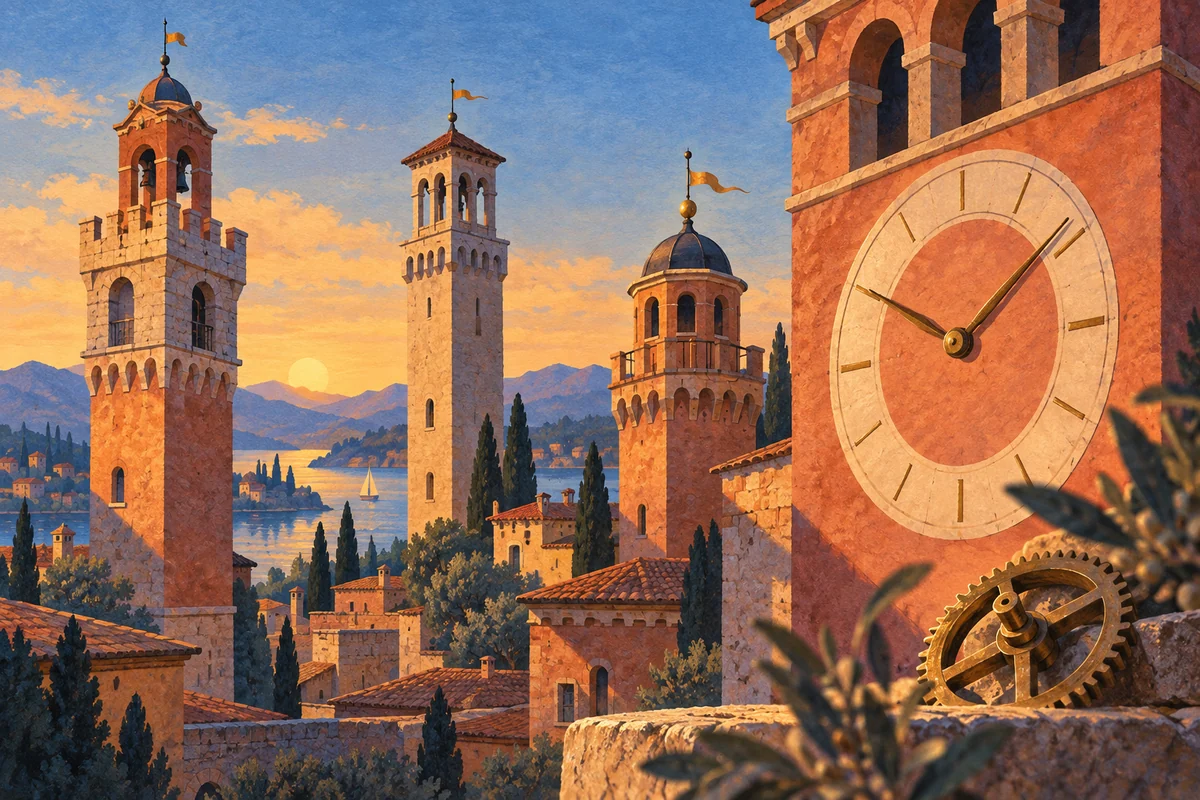
Our article on Italy’s civic clock towers considers a different subject: public mechanical timekeeping and the buildings around it. The technology-museum guide offers related ways to ask what an instrument does, while the museum-closing-day planner helps keep the surrounding route realistic.
Browse Italy’s history experiences if you want guided context, checking whether a solar instrument is actually included. The useful souvenir is not a claim that you have “checked the time” more accurately than your phone. It is an understanding that different instruments answer different questions—and that a patch of sunlight can turn an ordinary city stop into a surprisingly precise encounter with place and season.
Sources & further reading
Turn a good read into a great day.
Find a highly rated Italian experience that brings these stories to life.
Explore related experiences →