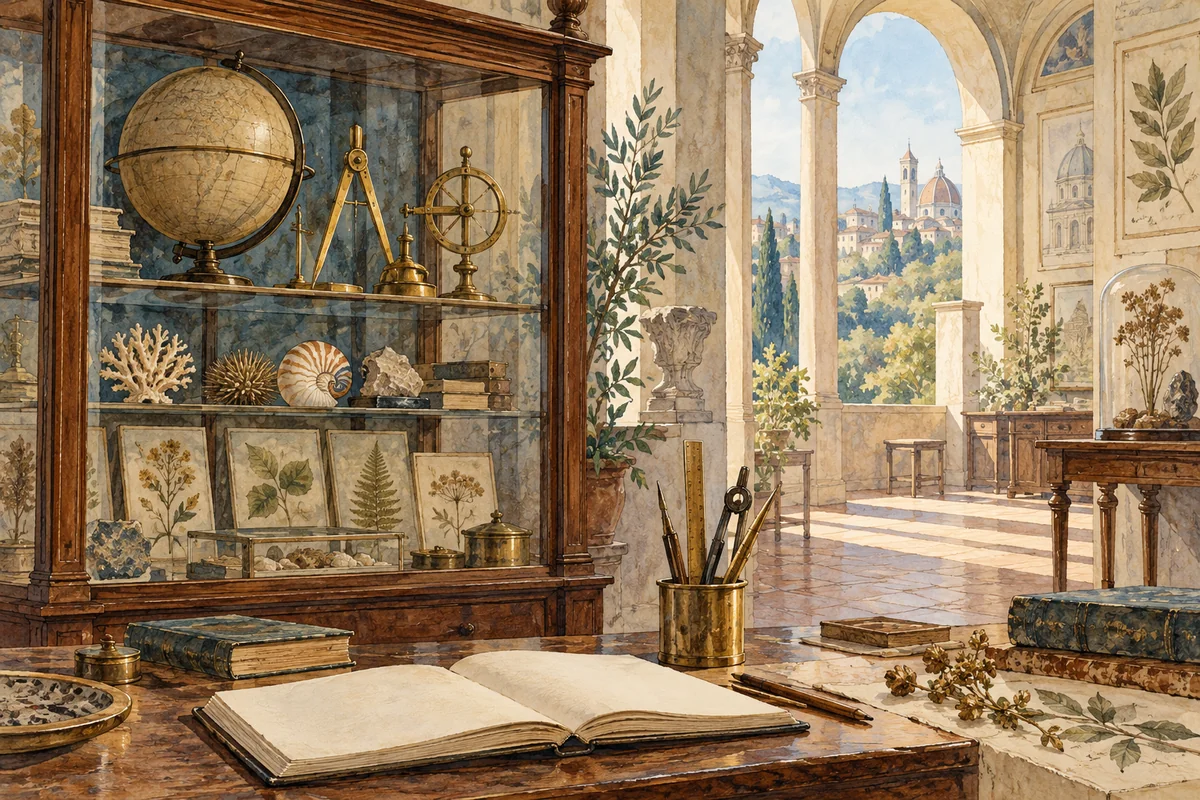
Herbaria in Italy: can you visit a collection of dried plants?

A pressed plant on a sheet can look modest beside a flowering garden. Yet it invites a different kind of attention: the specimen is kept with information about its identity, collection and place within a body of research. For travellers in Italy, the first practical question is whether that material is part of a public display or a working collection with restricted access.
Padua, Florence and Bologna make the distinction particularly useful. Their botanical institutions connect plants, teaching and scientific collections, but they do not offer identical visitor experiences. A garden ticket is not a general invitation into an herbarium, and a university’s online catalogue is not proof that the corresponding specimen is on display.
What are you looking at on a herbarium sheet?
Begin with the relationship between the plant material and its accompanying information. A sheet is more than a decorative arrangement of leaves. The label may tell you where and when material was collected, who collected it and how it was identified. Read what is actually recorded; a location on a label is not an invitation to infer an entire vanished landscape.
Look for the difference between a collection date and a later annotation. Scientific understanding can change, and the information attached to an object may develop over time. Where a public display explains a revised identification, that revision is part of the object’s intellectual history rather than a reason to dismiss it as unreliable.
These are viewing prompts, not instructions to handle collections. Follow the institution’s rules and leave mounting, storage and conservation to staff. A photograph may be a useful memory where permitted, but it does not replace the information that makes a specimen meaningful.
Padua: a public selection within a larger collection
Padua’s botanical museum describes its Galleria degli Erbari as a selection of historic sheets drawn from much larger holdings. The gallery introduces collectors and different botanical material, including the youthful collecting activity of the artist Filippo de Pisis. Its account separately identifies the historic herbarium as a collection consulted for research by appointment.
That separation is exactly what a visitor needs to understand. You can plan to encounter a curated display without expecting access to storage or the whole research collection. The selection is not a disappointing fragment of an imagined complete tour; it is a public interpretation designed to make particular stories legible.
Choose one sheet and read it slowly before scanning the others. Compare the scale of the material, the arrangement and the label, while avoiding conclusions about rarity or scientific importance from size alone. An apparently ordinary plant may be interesting because of its documented context, not its visual drama.
Florence: research access is not tourist admission
The University of Florence describes its botanical collections as available for research rather than ordinary tourist visits. Its current collection page also warns that digitisation work limits physical access and loans. This is an operational research notice, not a suggestion that any traveller can secure entry by requesting a convenient time.
The university’s botanical garden is a separate public destination, with its own entrance and seasonal visitor information. Check that page if you want to see living plants in Florence. A restricted herbarium and an accessible garden can both belong to the same institution without sharing an admission route.
Our guide to Italy’s university museums explains why research institutions reward precise planning. If your interest is primarily a living collection, start with building a botanical garden into a city break and keep the two kinds of visit distinct.
Bologna: read the current notices before travelling
The University of Bologna’s garden and herbarium page restricts herbarium consultation to documented study by appointment. It publishes separate public opening information for the garden, including a shorter winter schedule, and currently carries notices about works affecting parts of the site. Check those notices rather than treating the name of the institution as a promise that every area is open. Our local guide to a small seasonal focus in Bologna’s botanical garden can help shape the public visit.
A living garden can help you think about form, growth and the conditions in which plants are displayed. A herbarium can preserve material for a different purpose. Neither should be reduced to a substitute for the other, and neither gives a casual visitor grounds to make claims about a plant’s medical use or safety.
Plan a botanical visit around an answerable question
For a public display, ask what one labelled specimen can tell you about collecting and record keeping. For a garden, ask how the institution explains a living plant’s identity and context. The comparison can be rewarding across separate trips; there is no need to connect all three cities in a short itinerary simply to complete a list.
Our article on visiting Italian libraries offers a related lesson about public interpretation and working collections. Browse Italy’s arts and culture experiences for broader plans, while confirming any named botanical institution independently. The best outcome may be a single carefully read sheet, together with a clearer understanding of why most of the collection remains behind the scenes.
Sources & further reading
Turn a good read into a great day.
Find a highly rated Italian experience that brings these stories to life.
Explore related experiences →