Bologna and Turin on foot: how do their porticoes shape a walk?

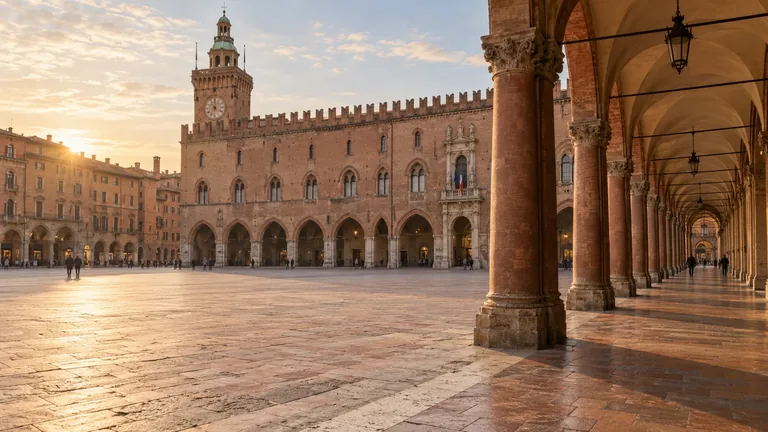
Walk beneath the porticoes of Bologna and Turin on the same trip and the temptation is to give both experiences the same caption: Italy in the rain. Shelter is real, but it barely begins to explain how these streets work. In Bologna, one arcade can change character at the next property line. On Turin's Via Po, a diagonal avenue gives the covered walk a long direction of travel. A portico is an excellent instrument for reading a city because you can use it while doing the most ordinary thing in the world, walking to lunch.
Try one block in Bologna
Choose a short stretch where you can stop without obstructing a doorway. Look down first. Where is the line between the floor under cover and the paving exposed to the sky? Then look across the street. The columns belong visually to the building above, but the space underneath carries people who may never enter that building. Shops and front doors use the sheltered edge. A walker, a person waiting for a friend and somebody stepping out with a parcel can all have a different idea about which part of the space is theirs.
The UNESCO description of Bologna's porticoes identifies a serial property made up of selected components, with a range of periods, building types and uses. The inscription covers specific parts of a much larger citywide system. A portico can be perfectly representative of daily life without belonging to one of those selected components. If you are visiting to understand the designation, locate the particular component on the official map. If you are simply curious about city streets, the arcade between your stop and your destination may already offer the most useful sample.
Follow three bays rather than three kilometres. Does the rhythm of the supports line up with the windows overhead? Does the covered width change where a neighbouring frontage begins? Notice whether the floor is level at that join. Small differences have immediate consequences for someone pushing a pram or walking beside a companion. Our guide to the materials in Italian streets can help you name a change in brick or stone without assigning a date on appearance alone.
Use the long view in Turin
In Turin, find Via Po on a map before you step under its arcade. MuseoTorino's account of the street describes how it cuts diagonally across the city's more regular grid and connects the castle area with the crossing towards the river. The portico helps tie that diagonal together. Look along several building fronts before choosing an individual detail. An opening to a side street interrupts the view very differently from a doorway into a café.
A simple game is to choose a distant point straight ahead and take a short stretch towards it. For the first half, notice the dark and light intervals on the pavement. For the second, watch what happens to your sense of direction when you step into an open square. A covered route funnels attention along its length. A square invites it to wander across a wider field. Reading a civic square immediately after an arcade makes both kinds of space much clearer. You can do the exercise on either side of a well-timed coffee.
Plan for crossings, weather and rest
On a wet day a line of arcades provides considerable shelter. It does not remove the need to cross streets or make every pavement equally dry. Wind can drive rain sideways, smooth floors can become slick, and a continuous-looking line on a map may meet a change of level. For a group with different energy levels, pick a short section with several possible places to stop, using the mixed-energy walk guide as a starting point. Identify a real meeting place, such as a particular café entrance, rather than saying “under the arches” in a city full of them.
When comparing walking experiences, see whether the guide proposes a route through specific streets or simply uses the porticoes as a setting for another subject. Both can be enjoyable. The difference matters if someone is travelling to understand architecture. In Bologna take a photograph across one seam between buildings. In Turin take another along the sweep of Via Po. Placed side by side, the images answer a better question than which city has the prettier arches: what does each city make possible for the person on foot?
For two specific places to try the comparison, read the city guides to Bologna’s timber and masonry porticoes and Turin’s Via Po.
Sources & further reading
Turn a good read into a great day.
Find a highly rated Italian experience that brings these stories to life.
Explore related experiences →